

The year 2025 got off to an active start in terms of weather in the Tennessee Valley. For the first couple of months of the year, it was mostly cold weather and off and on wintry conditions. A major winter storm affected a large part of the Tennessee Valley and adjacent areas from the overnight of January 9th through the morning hours of January 10th. A widespread 4 to 7 inches of snow accumulation was observed across a large part of southern middle Tennessee and along and north of the Tennessee River area in north Alabama. Snow accumulations of 2 to 4 inches could be found all the way south into central portions of Alabama in the Birmingham metro area. In addition to the significant snow accumulations, sleet and freezing rain near and south of the Tennessee River in north Alabama led to icy conditions, and major travel disruptions lasted for several days.
There were a few additional flurry/dusting type snow events in the remainder of January 2025, but the next big deal was the major Arctic outbreak of cold air around January 19th – 21st. This cold air outbreak was also associated with the historic winter storm that occurred to our south along the Gulf Coast during the same timeframe. Locally at home, overnight lows got as low as the single digits with wind chills below zero, leading to a few days of pipe-bursting type cold.
We shifted to milder weather for a time in the first half of February, before sliding back to wintry conditions just past the middle of the month. Another winter storm targeted the Tennessee Valley around February 18th and 19th. This time, the heavier snow totals were to the north of our local viewing area, but we still had local snow accumulations of 1 to 3 inches across most of southern Tennessee and north Alabama. While there were disruptive travel conditions, thanks to the sun angle getting higher and conditions not quite as cold as with the winter storm back in early January, most main roads were clearing up across the area just a day or two later.
The Tennessee Valley was certainly no stranger to severe storms and tornadoes this year either! Coming out of cool ENSO neutral to weak La Nina conditions, having a strong -PDO in place, and the weakening ENSO configuration driving a strongly positive Trans-Nino Index pattern for the duration of spring, the global players were on the field for an active tornado season in the Mississippi and Tennessee Valleys, and that’s exactly what happened.
Our first significant tornado event of the year happened the night of February 15th when a line of severe storms crossed the area. The most notable event to happen with those storms was the damaging EF1 tornado that hit Tuscumbia and Muscle Shoals. We were able to catch the power flashes live on our Arctic Air Skycam Network, and we caught initial signs of rotation approaching the Shoals metro from the southwest. This allowed us to give Tuscumbia and Muscle Shoals eight minutes of advance warning to seek shelter, even though an official NWS issued tornado warning was not in place before the tornado hit.

Significant severe storm and tornado threats continued right on through spring and into the early summer months. Parts of our local area were placed in a rare “High Risk” of severe storms on March 15th, part of a two-day violent tornado outbreak across the Mississippi Valley and Deep South. While there was one confirmed tornado near Rogersville, AL, fortunately, the more violent storms that day stayed off to our south. We were not as lucky as we moved into the end of March and then April. As a warning shot, our area had a significant severe weather event on March 31st that produced a killer EF2 in the Hampshire, TN area in Maury County. Then, our local area had almost daily tornado threats from April 2nd through April 6th. Of particular note was the deadly Selmer, TN EF3 tornado during the overnight of April 2nd and then the supercell complex that produced multiple tornadoes across our north Alabama counties the evening and overnight of April 6th, including yet another significant tornado hit to Sheffield, Tuscumbia, and Muscle Shoals.
Yet another significant tornado event occurred across the Tennessee Valley on May 20th. Multiple rounds of supercell storms produced several low-end tornadoes first from near Waterloo, AL up into middle Tennessee during the midday to early afternoon hours. During the late afternoon and early evening, a wave of more intense supercell storms produced multiple tornadoes across north Alabama, including an EF1 tornado near the Ford City, AL area that stayed down to near the Elk River Bridge area east of Rogersville, and two separate EF2 tornadoes… one from near Tanner, AL to the west side of Huntsville that prompted a rare “Tornado Emergency” for the Huntsville metro, and a second EF2 from the same supercell complex on the east side of Monte Sano near the Killingsworth Cove area that continued on the ground over into Jackson County. Another sneaky low-end supercell event produced a short-lived EF0 tornado near the Marshall Space Flight Center in Huntsville, AL. An additional supercell that day may have produced another weak tornado just outside of the Lacey Spring area in Morgan County, AL, but survey results were inconclusive. Occasional severe storm and tornado warning events continued across the Tennessee Valley right into early June.
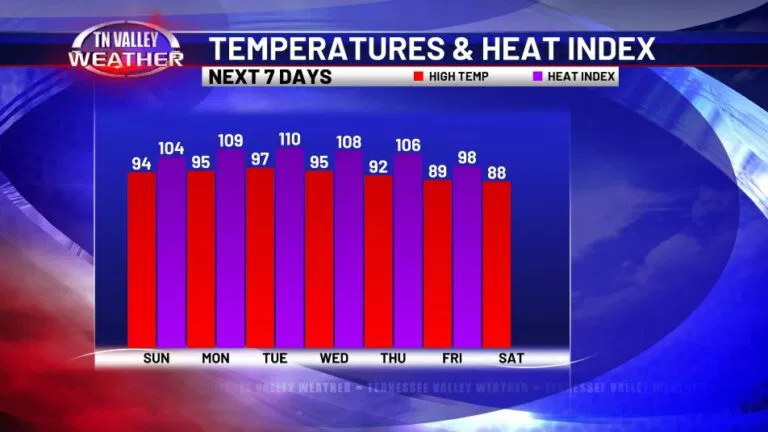


The active weather shut off as we made our way into summer and shifted into a hotter weather pattern. We were greeted with high temps in the upper 90s and heat index values as high as 110+ as early as mid/late June, and that repeated itself multiple times through July and into August as well. The upper ridging driving this heat also meant less in the way of widespread summer storms for significant periods of time. Rainfall substantially slacked off once we got to July, and then we’ve been running mostly behind on a monthly basis for the rest of the year. This has led to drought conditions being re-established across the Tennessee Valley after being completely wiped out in the first half of the year. Fortunately, while there were several major hurricanes in the Atlantic basin this year, there was not a single hurricane landfall on the mainland United States coastline!